There are no items in your cart
Add More
Add More
| Item Details | Price | ||
|---|---|---|---|

A lot of the events taking place in cells and organisms are explained in terms of the Chemistry involved. For students with little or no background knowledge of Chemistry this can be a big problem. This blog post will cover the most basic ideas, leaving a study of the Biological molecules to the relevant lesson within Biology.
The Smallest Particles - Atoms and Molecules
Trying to discuss the particles involved in the Chemistry of life is like dismantling a Russian doll, or an onion, there always seems to be another layer beneath. Atoms are the smallest particles that form a chemical element. The smallest particles that can’t be broken down by chemical means. As I just implied, they’re made up of other particles but atoms are a good place to start.
Very few atoms move around by themselves, for the most part they are found joined together with other atoms to form a molecule. The smallest atom is hydrogen and left to its own devices that will join with another hydrogen atom to form a hydrogen molecule. Molecules are just the term for a group of atoms chemically joined together.
The number and types of atoms within a molecule are what give that molecule its particular properties. Hydrogen molecules are just two atoms of Hydrogen and the molecule they form is an explosive gas. Similarly, Oxygen molecules are just two atoms of Oxygen joined together and they form another gas. When Oxygen gas and Hydrogen gas are joined together we get a molecule with two atoms of Hydrogen and one atom of Oxygen which is neither a gas nor explosive - it is just water.
There are only 118 different types of atom, but there can be millions of atoms joined together to make a single molecule and changing the position of any of those atoms within the molecule can make an entirely different molecule, with different properties.
Inside The Atom
Atoms are joined together by bonds. There are a few different types of bond and the type of bond will affect the properties of the molecule. To understand the bonding we need to consider how an atom is made up.The atom can be thought of as a sphere, with a dense central core surrounded by a series of layers referred to as shells or orbitals where electrons move about. It is the movement or sharing of the outermost electrons in an atom that is responsible for how it bonds with other atoms to form a molecule.
Most of the mass in an atom is found in the dense central core, the nucleus. The nucleus is positively charged and this charge is what attracts the negatively charged electrons in the outer shells. The charge on the nucleus comes from the positively charged protons it contains. The number of positively charged protons within the nucleus is what governs how many negatively charged electrons the atom will contain, which governs the properties of the atom and is therefore used to categorise the atom as one type of element or another.The nucleus also contains neutrally charged neutrons. The number of protons and neutrons in the nucleus gives the atomic weight of the atom, but it is the protons which determine its properties. The mass of an electron is negligible compared to the mass of a proton or a neutron. Carbon has six protons in its nucleus. Some Carbon atoms have 6 neutrons to give an atomic weight of 12 whilst others have 8 neutrons, giving an atomic weight of 14, but they behave the same because the 6 protons lead to 6 electrons and that’s what gives both atoms the same properties.
When an atom either loses or gains an electron the charge on its nucleus will no longer be balanced by the charges on its electrons, giving the atom an overall charge. Atoms with a charge are called ions.The outer shells where the electrons move about have particular shapes and can hold specific numbers of electrons.
Being further away, the outer shells of electrons are influenced by the charge on the nucleus less than the closer shells of electrons. The electron shells are filled up in sequence and it is the extent to which these layers are full, their distance from the nucleus and the charge on the nucleus which govern how the electrons behave during bonding.
Bonding
It is the nature of the bonding within a molecule that is the principle characteristic responsible for its properties and it is the arrangement of electrons in the outer shells of the atoms of the molecule which determines that bonding.Each electron shell is able to hold a specific number of electrons. Once a shell is full the next electrons go into a shell further from the influence from the nucleus and shielded by the inner electron shells. When bonds are formed electrons may be gained, lost or shared and this determines the type of bond that is formed. In each case the most energetically favourable configuration is for the outermost electron shells to be as full as possible. Atoms where the outermost shells are only partially full are less stable than those with full outer electron shells. Atoms gain stability by achieving an outer electron shell which is full.
The sodium atom has just one electron in its outermost electron shell whilst the outermost electron shell in the chlorine atom is one short of being full. When sodium and chlorine bond the sodium atom loses an electron and the chlorine atom gains one. Both atoms become stable due to this arrangement. The sodium atom formed by this will have more positively charged protons than negatively charged electrons, it will have an overall charge of +1, since the atom has an overall charge it is now referred to as an ion. The chlorine ion will have an extra negative charge from the electron it received giving it an overall charge of -1, because of this charge it is also now referred to as an ion. These charges on these ions will electrically attract each other and the two ions will be bonded together.
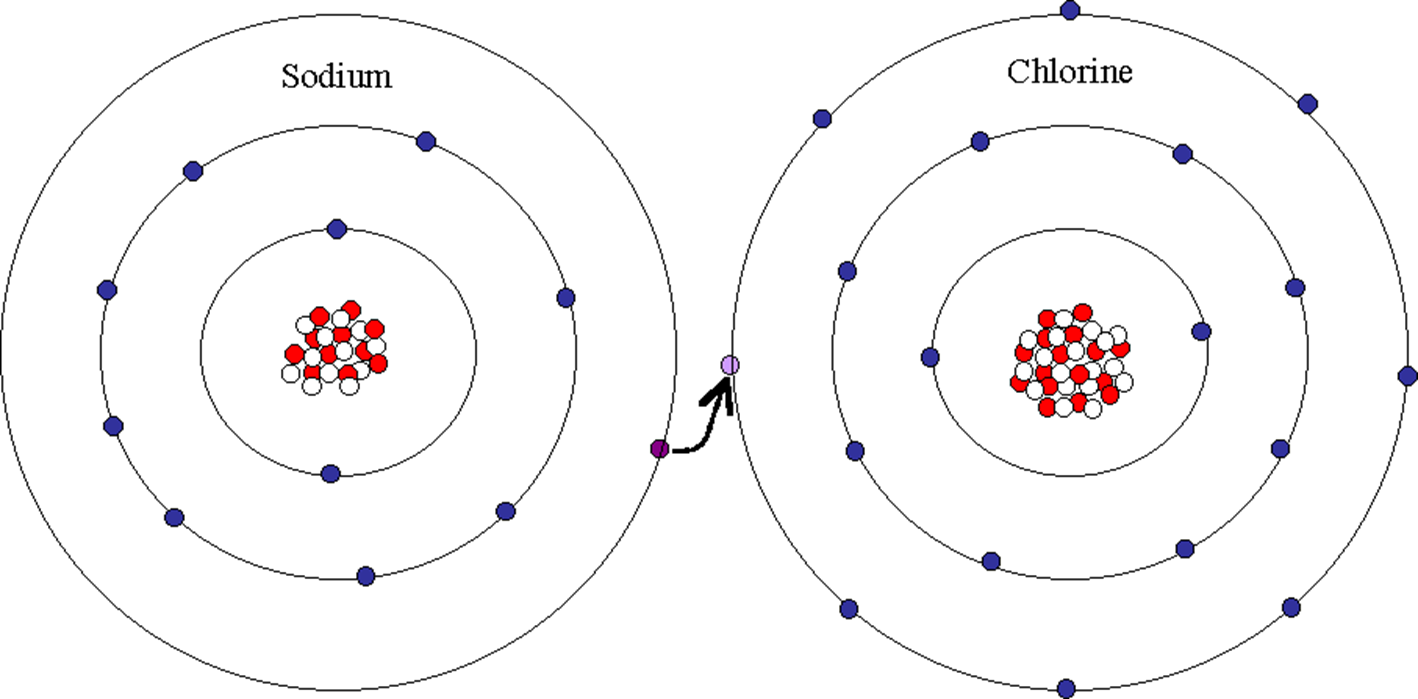
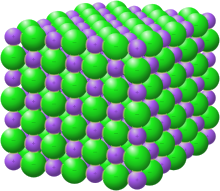
Bonds formed due to the charges resulting from electrons moving from one atom to another are called ionic bonds.The ions in a molecule formed by ionic bonding are held in a regular crystalline arrangement. Ionic bonds are not as strong as the covalent bonds we will look at next. If the ionically bonded crystal melts or dissolves the weak ionic bonds will break and the electrically charged ions will drift apart.
More stable bonds, called covalent bonds, are formed when atoms share electrons. Diamonds are made of carbon atoms covalently bonded to other carbon atoms. Water also uses covalent bonding. A water molecule is very stable. It is hard to break the bonds within the molecule. Water is formed when oxygen shares an electron in its outermost shell with two atoms of hydrogen. The outermost electron shell of the oxygen atom needed two electrons to become full whilst the hydrogen atoms each needed one extra electron to achieve a full outer shell. By sharing electrons oxygen and hydrogen both achieve a full outer shell and a stable bond between them is formed.

The position within molecules of the atoms, their nuclei and electron shells can lead to very significant properties. The water molecule has an overall balance of positively charged protons and negatively charged electrons, but the positions of the charges mean that the oxygen end of the molecule has a very slight negative charge and the hydrogen ends of the molecule have a very slightly positive charge. The molecule is said to be polar, one end is positive and the other is negative.
These weak electrical charges create a slight attraction between neighbouring molecules and are responsible for the very unusual and highly significant features of water. A molecule with such a low molecular weight would normally be a gas at room temperature but the water molecules stick to each other and form a liquid. Water is of such importance to biology and has such unusual properties that it deserves a lesson all of it's own.
The weak force of attraction between neighbouring water molecules is called hydrogen bonding. Uneven charge distribution can cause a similar weak force of attraction in other molecules, especially where there are oxygen-hydrogen, nitrogen-hydrogen, carbon-oxygen or carbon-nitrogen bonds. If a hydrogen atom is involved it is called a hydrogen bond, if not it’s just referred to as a type of very weak ionic bond.
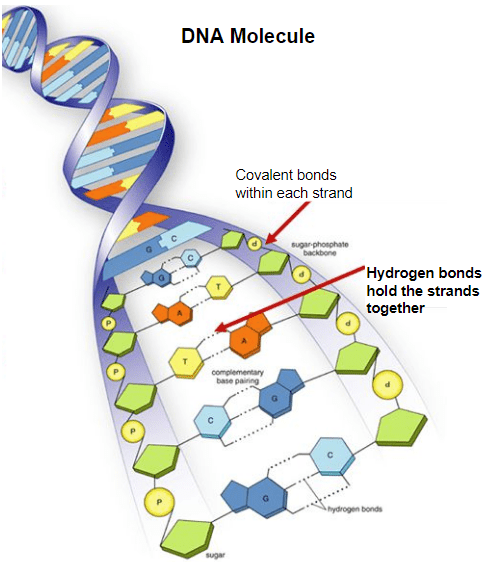
The molecules involved in living systems tend to be quite large. Strong covalent bonding are needed to hold these macromolecules together, but hydrogen bonds and occasionally ionic bonds often hold the macromolecules in a particular three dimensional shape, which is usually crucial to the biological properties of the molecule. Individual hydrogen bonds are very much weaker than covalent bonds but their collective effect can be very significant. They’re a bit like the hook and loops in a velcro fastening, hundreds of weak attachment points working together can be very strong. Hydrogen bonds are what hold the two strands of a DNA molecule attached to each other.
Carbon
Carbon is such a significant atom in biology and chemistry that there is a branch of chemistry entirely devoted to it. Organic chemistry is the study of carbon compounds in living systems.
Carbon has such significance for two main reasons. Carbon to carbon bonds are easily made and very strong. This means that large stable molecules made with a carbon skeleton are possible and other atoms may be bonded to the carbon skeleton. Also, carbon normally forms four covalent bonds which splay out in different 3 dimensional directions. Taken together, these features mean that carbon compounds can form very large and stable molecules with a massive array of different shapes. Interestingly, when each of the four covalent bonds on a carbon atom are attached to a different thing the 3-dimensional structure has two different “chiral” forms. Chiral forms are mirror images of each other, in the same way that our left and right hands are mirror images of each other.
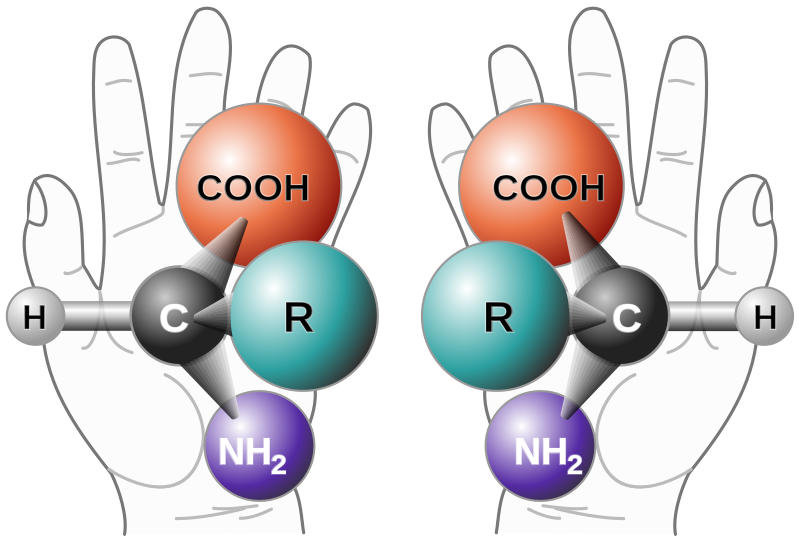
In Biological systems the shape of a molecule can be extremely significant, one chiral form of a molecule may seem chemically identical to another, but it won’t fit the active site of an enzyme or transmit messages like a hormone in the same way that the other chiral form of the same molecule is able to.
The vast majority of important molecules in cells are organic - they have a carbon backbone. The simplest organic compounds, called hydrocarbons are formed from just carbon and hydrogen but most biological compounds have other functional groups attached to the carbon skeleton which affect the charge distribution and three dimensional shape of the molecule. These functional groups attached to the carbon skeleton are typically formed from particular arrangements involving oxygen, hydrogen, nitrogen, phosphorus and sulphur and give the molecule as a whole its important characteristics. Examples of common functional groups include:
The Influence of water on macromolecules
It is the weak charge difference between different ends of the water molecule which leads to its huge significance to living systems. One or other end of the water molecule will attach to the part of another molecule which carries a charge, large or small. Molecules which lack a charge, such as those with lots of carbon to carbon or carbon to hydrogen bonds do not attract water molecules. Since the charged water molecules stick each other, the non charged molecules are left clumped together without water. This tendency of non charged molecules to exclude water and clump together is called being hydrophobic, water fearing.
Parts of organic molecules with carbon to oxygen, oxygen to hydrogen and nitrogen to hydrogen will have a less even distribution of charge in their bond, allowing water to stick. This behaviour is called being hydrophilic, water loving.
Since all living systems are associated with water as a solvent, this clumping or opening of different parts of the same molecule can also have a significant role in forming the three dimensional shape and behaviour of large molecules.
 Launch your Graphy